
A Preference
In Simone de Beauvoir’s 1948 essay- Second Sex, she proposes that given a choice between a binary of two, the chooser will always have a preference. Light is preferred to dark, up is preferred to down and historically – man is preferred to woman. The lesser of the two is nearly always defined through the lens of the greater. These preferences become ingrained biases, both personal and societal. Particularly the preferences of gender.
“Humanity is male and man defines woman not in herself but in relation to himself; she is not considered an autonomous being.”
― Simone de Beauvoir, The Second Sex
Simone’s essay offers a critic of that preference in the binary of men to women. I want to explore a bit how I have seen this phenomenon through literature.


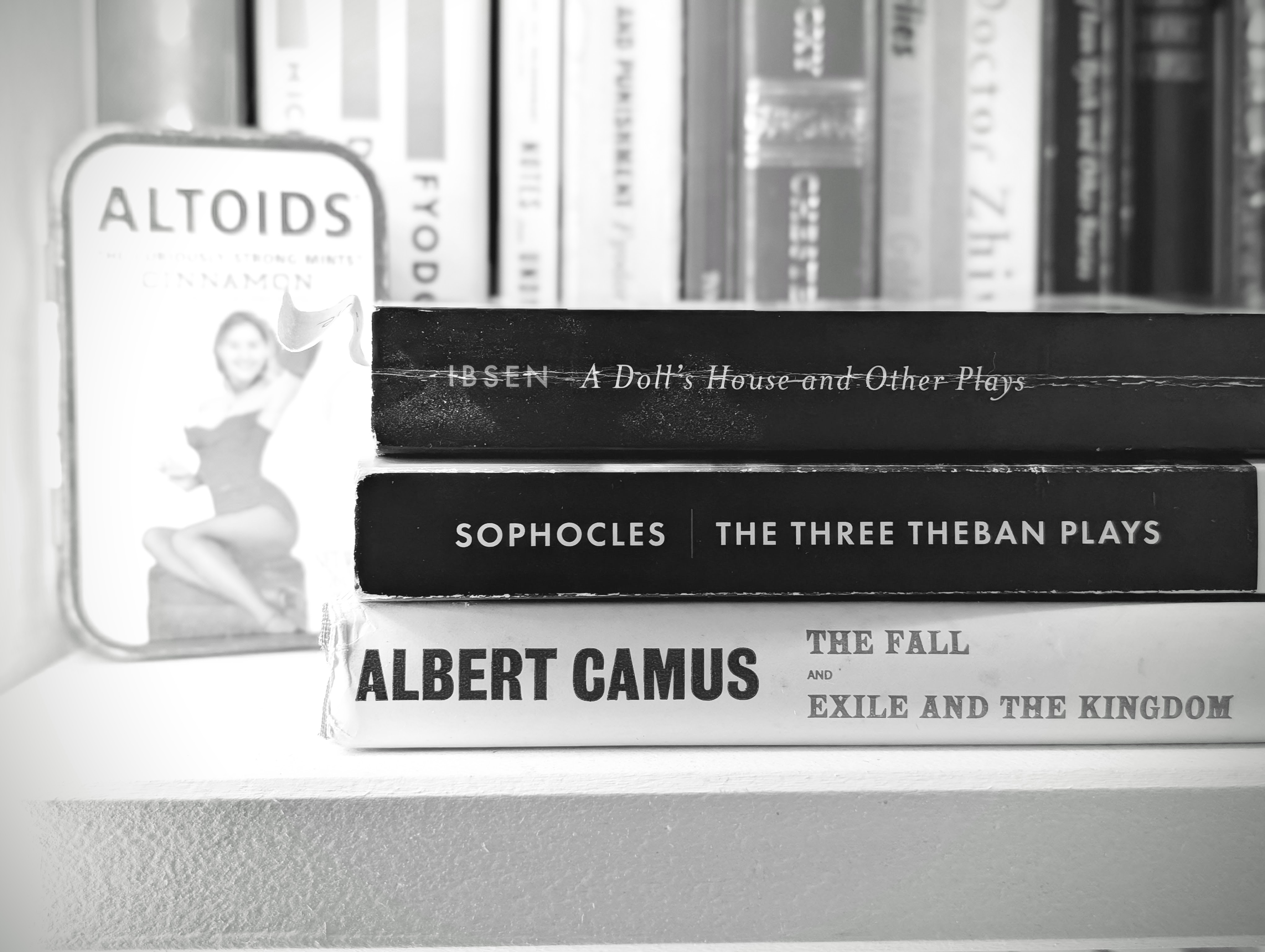
Since we began our book club in 2022, the books we’ve read have largely fallen into the genre of the classics, where men often hold the center stage. Brothers Karamazov, No Country for Old Men, East of Eden, even Mary Shelley’s Frankenstein. I wasn’t the only person in our group to notice this, so I began looking for opportunities to explore literature through the eyes of women, and I met some wonderfully unsettling and inspiring authors and characters. The 1879 Henrik Ibsen play, A Doll’s House and the 441BC Sophocles play Antigone were the two choices that made it to our reading list that second year, both plays with female centered narratives written by men. I also want to discuss a short story that I read by Albert Camus titled The Adulterous Woman… I know, all male authors, I will definitely be including female authors more often as the years go by.
The Idea of being a “Her” Nora
Henrik Ibsen wrote his play A Doll’s House in 1848, it absolutely blows my mind how old this play is for how progressive it is. The play is centered around Nora, a married woman with two children who is running a bustling household in an unnamed 19th century Norwegian town. But she has a secret that she has been keeping. Unable to pay the money they needed for the medical treatments to save her proud husbands life, she borrowed money under her dead fathers name and has secreted the payments to her borrower over the years. Women in the 19th century could not borrow money or open a bank account. A banker himself, her husband Torvald was too proud to stoop to borrowing money, looking down on those in debt, so Nora was left to hold this burden alone and in secret. Until that is, her lender comes seeking repayment and threatens to reveal it all. Nora struggles to dance her way around the issue, scheming various solutions, but to no avail.
In the concluding scene, Nora reveals her secret to Torvald in hopes of a miracle that he will shoulder the blame, unfortunately it only stirs his anger at what this debt and blackmail of hers burdens him with. He is wholly unappreciative of her sacrifice for his health and well being. In the dust of his outburst, Nora realizes that her husband doesn’t know her, and doesn’t love her but only the idea of her. That her father never knew her, they both treated her like a little doll who was to hold their vision of the world. Worse still, she didn’t even know herself. She sees within herself a stranger. So, Nora decides then and there to leave her husband and family to find herself. Nora puts on her jacket and walks out the door, the end of the play punctuated by the sound of Nora walking through and closing that door.
Nora in the beginning of the novel sees herself through the male lens, through her husband and her father. In this 18th century system of society Nora is an ornament for the men in her life. When she seeks autonomy, she must do so outside the system. This system she chooses to leave at the end of the play and invites us to consider both the impact of her exit and the system that forced her to make that choice.
The Undeniability of Antigone
Antigone is the third play in the Oedipus series of plays written by Sophocles. In the tale of Oedipus, Oedipus the King attempts to escape his prophesied fate of murdering his father and marrying his mother by running away. Fate being fate though, Oedipus ultimately discovers that his attempts to escape his fate led him to fulfill it. Though he discovered his error only after producing four cursed children with his mother/wife, of which one is his daughter Antigone.
The play of Antigone begins following a civil war for the kingdom. Her two brothers, on opposing sides kill one another in combat for control of the city leaving their uncle, Creon, in charge. King Creon decrees one brother to receive a royal burial and that the other to be left on the battlefield to rot. Anyone who buries him will forfeit their life. Antigone for love of her brother and honor for custom is caught burying her brother and is sentenced to death. Alive, Creon seals her in a tomb – buried alive while her brother’s body rots above ground.
The unexpected consequence of Creon’s decree is that it extends the curse to him. Defying the custom of burying the dead that would allow their soul to depart to the after life, Creon’s actions bring consequences to his own household, losing the lives of both his son and wife.
While Antigone is a cautionary tale towards leaders like Creon to be attentive to their constituents rather than preoccupied with their own power. It does so through the lens of Antigone who operates completely through the patriarchal system. Antigone places the truth, her own moral conviction above the system, though unlike Nora she doesn’t question her place in the system itself. The play regularly shames Creon for his inability to see the moral truth Antigone presents him because he sees women as less than men, even when other men, prophets and his own son point out his mistake, he persists. His blindness to this brings suffering to his family and the kingdom.
In both stories, the system of male dominance traps and oppresses women, both Creon and Torvald suffer from their arrogance and blindness. Antigone, tragically alone in a cave and Nora venturing out in the world alone.
The Acceptance of Janine
Nora, Antigone and now Janine, our protagonist in The Adulterous Woman. A short story written by the French author and play wright Albert Camus in 1957. In which, Janine and her husband Marcel, take a bus ride to the south of Algeria so he can sell directly to the Arab merchants. Again, a woman trapped – trapped on a bus and trapped in a 25 year amicable yet tedious marriage. It is a beautifully written story playing with the alienation of French colonialists in an Arab/Algerian region post World War Two held in tandem with the alienation that Janine feels in her marriage to Marcel, an aging garment salesman. Being in a world, yet not being a part of it and being a self, yet not herself. This story isn’t of a woman trapped in the tragic cave of Antigone, or the tower of social criticism of A Doll’s House. It’s the alienation of self and the lost youth which Janine wrestles with in 20 pages, culminating with Janine alone at night venturing to a vacant roof to gaze at the stars and reflect on her emptiness.
I fell in love with this story for two reasons. First of all its beautifully written. If Don Quixote makes me want to learn Spanish, Camus makes me want to learn French.
After so many years of mad, aimless fleeing from fear, she had come to a stop at
last. At the same time, she seemed to recover her roots and the sap again rose in
her body, which had ceased trembling.Her whole belly pressed against the parapet as she strained toward the moving sky; she was merely waiting for her fluttering heart to calm down and establish silence within her. The last stars of the constellations dropped their clusters a little lower on the desert horizon and became still. Then, with unbearable gentleness, the water of night began to fill Janine, drowned the cold, rose gradually from the hidden core of her being and overflowed in wave after wave, rising up even to her mouth full of moans. The next moment, the whole sky stretched out over her, fallen on her back on the cold earth.
The Adulterous Woman – Albert Camus
Second, I love that Camus ties the plight of Janine with the plight of the colonial occupation of Algeria. It runs parallel and with equal concern to Janine’s alienation of self.
Since the beginning of time, on the dry earth of this limitless land scraped to the bone, a few men had been ceaselessly trudging, possessing nothing but serving no one, poverty-stricken but free lords of a strange kingdom.
Janine did not know why this thought filled her with such a sweet, vast melancholy that it closed her eyes. She knew that this kingdom had been eternally promised her and yet that it would never be hers, never again, except in this fleeting moment perhaps when she opened her eyes again on the suddenly motionless sky and on its waves of steady light, while the voices rising from the Arab town suddenly fell silent. It seemed to her that the world’s course had just stopped and that, from that moment on, no one would ever age any more or die. Everywhere, henceforth, life was suspended—except in her heart, where, at the same moment, someone was weeping with affliction and wonder.
The Arabs are always present in the story, they are certain of themselves, occupying a space that is familiar and possessed by them. Marcel, Janine’s husband is threatened by the alienating feeling of being among them. Janine is also unsettled yet unlike her husband, she is inspired to reflect on her place in the world, her lost youth and her absence of self. The story doesn’t end with a resolve like Antigone, its much more like A Doll’s House. Janine’s secondness to her husband seems to be compared to the secondness that the Algerians are supposed to be holding as an occupied people. It ends with a question of Janine’s place in the world, as well as the conflict of the French occupation of Algeria, yet another lens we could talk about.
The Revelation
Though not completely alien to power or hope, woman through history have suffered the position of second place. “Humanity is male, and man defines woman not in herself but in relation to himself; she is not considered an autonomous being.” (Simone de Beauvior – Second Sex) Yet, through these texts I see this position of “the lesser” being challenged, not revolutionary but revelatory, there is hope in these revelations.
There is a rootedness to Antigone, she knows herself. Through another story over 2000 years later in A Doll’s House, an uprootedness to Nora as she realizes she doesn’t know herself. 100 years later with Janine I see an enchanted re-rootedness, but one that she can’t explain. “It’s nothing, it’s nothing,” she says through her tears to Marcel.
Wisdom is the supreme part of happiness; and reverence towards the gods must be inviolate. Great words of the proud are ever punished with great blows, and, in old age, teach the chastened to be wise.
Antigone


Leave a Reply