
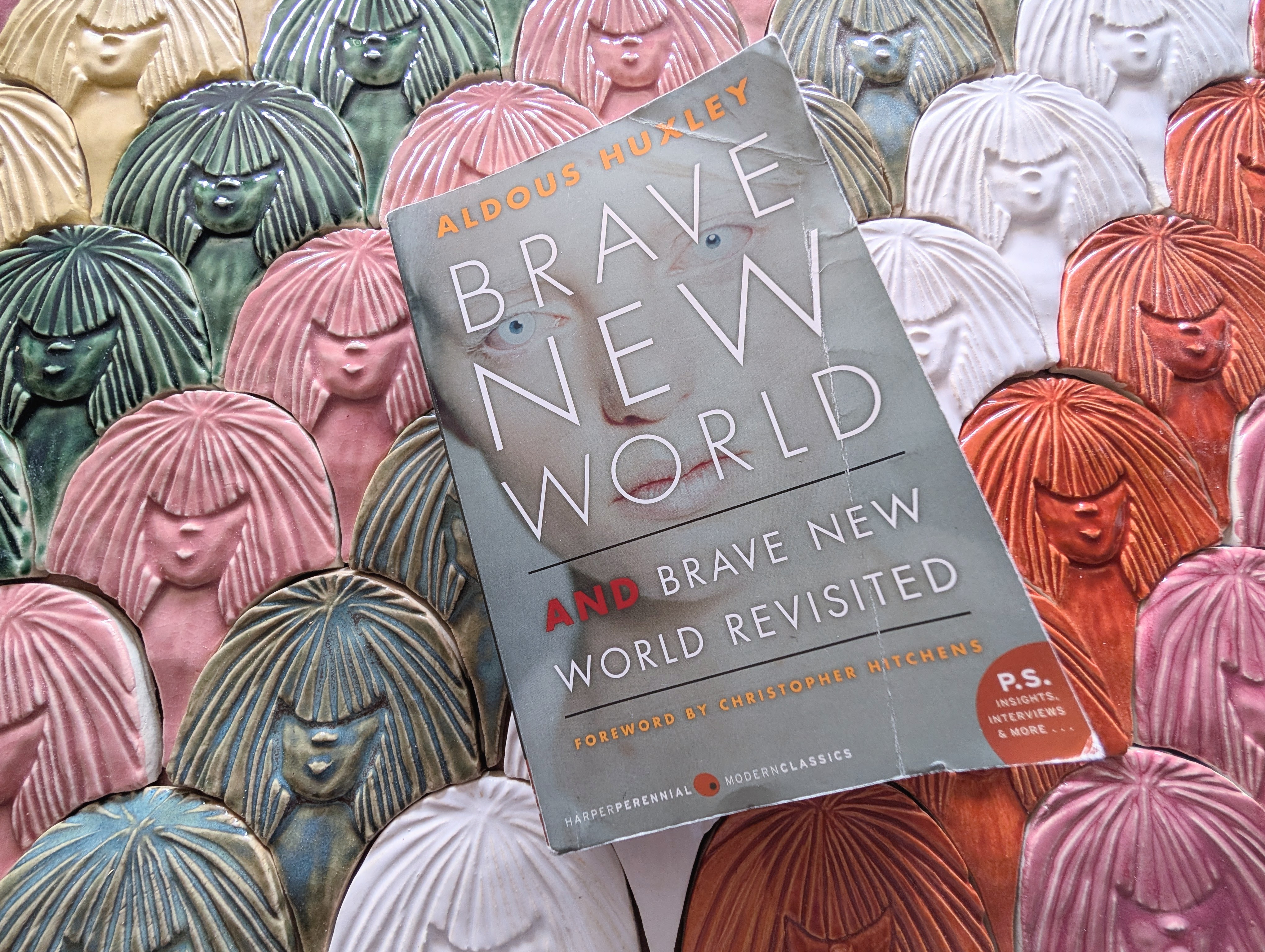
Brave New World is a tragedy, a tragedy of isolation, a tragedy of monistic thinking, a tragedy of superficiality. In this novel Aldous Huxley creates a global society ruled by Scientific Authoritarianism. The social conditioning in this world is nearly absolute, well…nearly. Throughout the novel we see the ends of this authoritarian society fraying. In a society where “everybody belongs to everybody”, Lenina is monogamy curious. In a society where “when the individual feels, the community reels”, Bernard longs for some sublime alone time. Helmholtz dangerously experiments with individual expression. Tomas, the director of Hatcheries, fathers a child, an act which results in his banishment from society in a world where children are grown in labs.
Brave New World is a global authoritarian society where happiness and stability are the chief ends and to gain that end, the individual is sacrificed completely for the universal. But humanity frays at the edges.
Into this world Aldous Huxley has injected an outsider. John the Savage, who has undergone his own very different conditioning in the wilderness of the Savage Reservation an area of the world deemed useless for society where indigenous populations are fenced off and left completely isolated from the world. Well nearly isolated as Savage John was born there in an accident when his mother was abandoned by her research partner. Pregnant and alone she had born a child, an unheard of social act which rendered her unable to return to the World Society.
In the Savage Reservation, John grows up as an outsider. A white man in an indigenous nation. He feels an outcast, desperate to be included but teased and spurned by the community. In his isolation, he learns how to read which further distances him from the community he lives in. His only book is The Complete Works of William Shakespeare a book banned in the World Society, which becomes a large part of his conditioning. He sees in it the pathos and sacrifice of the world he exists in, he embraces the humanity of Shakespeare as a founding text. When Bernard takes John and his mother Linda into the greater World Society, Linda dies and John becomes tragically unable to adjust to the existential conflict of the two societies. John ends a tragic character.
I think a lot about the tragic end of John. About his own conditioning, and how it limited him in both the Savage Reservation and the World Society. I couldn’t help but hope that Huxley would have made John a sort of synthesis of the two worlds, a hopeful character. Unfortunately John succumbs to the weight of his own conditioning. He fixates on purifying himself from the World Society and desperately seeks to recreate his old life in the Savage Reservation. Rejected by both worlds, his desire for purity drives him to self sacrifice, not for the world but for himself. The World Society treats him as a curiosity, and once rid of him returns to its stability.
Ultimately Huxley has written a criticism of the scientism of his age and the rising authoritarian social experiments of the 1920s-30s. And while John is a part of that criticism, for me John is also a cautionary tale. John’s lens for the world was incredibly small. He justifies his actions through the text of a single book, and no matter how beautiful Shakespeare can be he is not enough. This novel left me wanting to invite John into our book club, we could have discussed The Brothers Karamazov, East of Eden and Mary Shelley’s Frankenstein, expand his conditioning not calcify it in isolation.
Both the World Society and John the Savage could not tolerate their conditioning being challenged. Both ridged, inflexible and intolerant. It leaves me thinking about the social conditioning I’ve witnessed in our own society, and what that society does to those who question it. A world which demands a conformity to caste of thought, and how threatening those who challenge that conformity are. But also, I think about the foolish martyrdom of John. Poor John, so proud and so unhelpful.
Oh man, I didn’t even talk about Soma…


Leave a Reply